Pages

Showing posts with label quilting tools. Show all posts

Sunday, October 4, 2015

A bit of the same

Last year I made a banner for my daughter's hockey team.  This year she is in a different team so another banner was needed.


My plan was to make this years banner bigger.  Off I went to Pete's Emporium to hopefully buy the same fabric as last year.  One of the things about Pete's Emporium is that the stock changes - there was no yellow/gold or black like I'd used last year.  There was a stronger/thicker yellow and a small piece (less than 1m) of black.  The amount of black dictated the size of the banner - similar size to last year ~1m x ~1.5m. 

Using the no-pin technique with my current favourite for a range of quilting uses - blue painters tape.  

The words are printed in Word and are about 500 point.  


Freemotion quilted around each letter three times.  Way easier than trying to manoeuvre the weight of the material around all those curves and corners.


Removing the paper (well most of it).

The next step is to carefully cut away the black to reveal the yellow lettering - reverse applique.


Repeating the process for the Wellington Hockey emblem. 

To complete the banner, stitched the black to the yellow, added a full size peice of yellow to the back, then added the eyelets - one banner.


The banner has had one outing with another one soon.

Friday, May 15, 2015

More Ruler Work

I've continued playing with my Westalee rulers.  See here and here for previous posts.  

Note I've been using the Westalee ruler foot and not the freemotion foot that comes with my sewing machine.

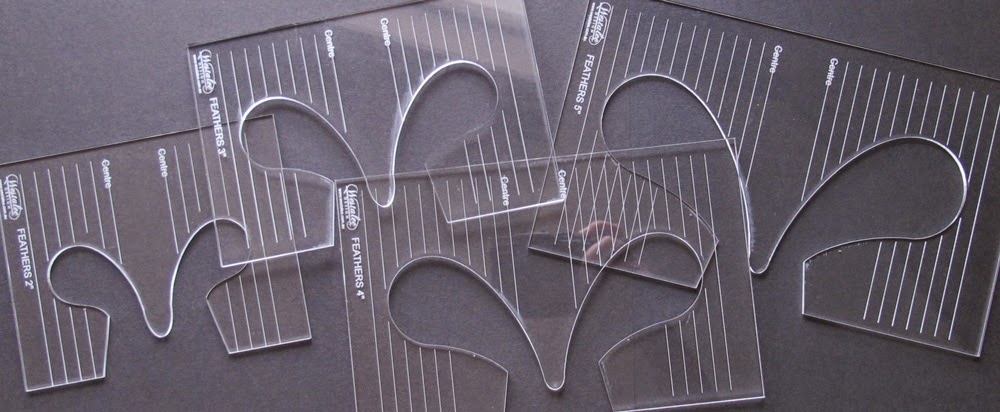
Trying the set of 4 feathers rulers ranging from 2" to 5".

While you could just pick up these rulers and use them I found watching (and sometimes rewatching) the Westalee video sped up the learning process quite a bit.  


No marking of the individual feathers is required however having a basting line or marking straight lines on either side of the feathers helps to keep the feathers uniform and straight.

Straight line of feathers using one sized ruler.


Wavy line with different sized feathers using a combination of rulers


Attempting curved cross-hatching using the Westalee straight and curved ruler.

 
I'm getting used to the edge of the ruler not being where the stitching line will be but 1/4" in from that.  This catches me out when I'm getting to the end of a shape and need to line the ruler up - it is too easy to line the edge of the ruler up with the point, start sewing then realise you're not going to end in the right place! 

Still working on getting the stitch length even and better start/stops ...

Monday, April 20, 2015

Ruler Work

Back here I posted about using the Westalee foot and rulers for freemotion quilting on a domestic sewing machine.  

I've been trying the Westalee 'Circles on quilts - wreath 16' ruler.  At the narrow end of the ruler there is a pin hole, a drawing pin is inserted from the back of the quilt and the ruler is placed on the pin.  One segment/shape is stitched then the ruler pivoted so the next segment can be sewn.  Finally joining up in a wreath shape.


ruler, centre pin
stitching


What I learnt:
* stabilise the area to be quilted first by stitching in the ditch.  Basting with safety pins isn't a good idea as the pins get in the way and the ruler doesn't cope with them nearby or underneath. 

stabilising in the ditch


* extra flat space is required so either use the sewing machine in a table such as a Sewezi or an extension table for the machine.  Having a reasonable amount of flat space is needed.  

* use the Supreme Freemotion slider as the under side of the drawing pin will get caught between the machine and the insert thingy.
slider on my sew ezi table


* the screw on the foot does need to be tight - interesting things happen if it comes undone.

* if there are any whoopsies stop and unpick.  If you keep going it probably won't meet up at the end leaving the wrong sized space for the final segment. 

* check that there is enough space on the quilt for the completed pattern before starting to stitch.   I didn't do this and was stitching across the batting. 


oops


This did have a happy ending as I realised that the pattern was quite interesting so stitched over the unpicked shapes but within the star.
partial stitching
 

I then needed to repeat this on the other star and realised that I could stitch until I reached the outline stitching of the star, backtrack, turn the ruler stitch the next segment.


Now to fill in the rest of the space and work on getting the stitch length even ... 


See here for Westalee's video for using this foot.  


Friday, August 29, 2014

Design Wall

I now have my very own design wall.  So no more (or maybe less) using the floor for trialling layouts. 

We bought a sheet of Fome Cor - Foam Board from PSP in Petone, who also delivered it.  The board is only 5mm thick and incredibly light, similar to the paper coated foam board available in art shops. 

The sheet needed to be trimmed to fit the space where it is to hang, super easy to cut with quilting tools! blunt (for fabric) rotary blade, ruler and cutting board. 
mitred plastic strips


plastic strips (the shorter edge is on the front)
The board is covered in thickish brushed cotton fabric that is mostly used for curtain interlinings - the extra layer between the curtain and the lining.  The fabric was cut a little larger than the board and fixed in place with plastic strips (Hardiglaze 6mm Premium Capping Mould - select accessories) purchased from a local hardware store.  The strip slides over the edge and holds the fabric without the need for glue.


The board is attached to the wall with 3M velcro-like strips that had been cut narrower. The velcro is on both sides so the board can be removed and turned around so the shiny side can be used.  

Works a treat, maybe my quilts will now get a bit bigger!
completed design wall - still no progress with the stars ...


Monday, May 19, 2014

Spring Fling - finished

A few days ago I posted here about my mini quilt using Sew Wonderful's Quick Curve ruler and their Spring Fling tutorial.  

It is now finished - I mostly followed the quilting as shown in the tutorial.

completed
a closer look

The quilt is ~28 inches square and will be given to the Neonatal Unit at Wellington Hospital.  I don't get too hung up about where it ends up, some quilts are used within the unit, some  given to parents to take home with others sold for fundraising.

This is the first one I've completed this year, I find this size really good for trying techniques, practicing my quilting and using up fabric.  They are also quick and easily finished pieces to do between (or during) larger projects.

Thursday, May 8, 2014

Spring Fling

'Spring Fling' is the name of a block by Jenny Pedigo of Sew Kind of Wonderful.  Some time ago I purchased her ruler when I was keen to try and master curves.  My first block was a complete failure and I threw it out.  (this wasn't due to the ruler!! more like operator error!!!)

I've continued to follow her blog and the other day had another go, this time with her new tutorial - Spring Fling.  


The block went together quite quickly and easily - even cutting the curves and sewing them was fine.  Only once did I need to unpick one curve because when I came to trim it - it was more like a parallelogram than a square!

What I did notice (and this may have been one of the reasons for my early failure) is that the ruler and patterns are for right-handers.  I'm left handed and sometimes I found I was holding the ruler quite awkwardly.  The next time I use the ruler I'll put the pattern/pictures upside down - hopefully then it will be easier.

As I didn't have any of the orange/white fabric left and hardly any of the checked decided that this could be a Neonate quilt.  Added a couple of borders to get it upto the required 27" size.  Now to quilt it ...

Jenny has a giveaway on her blog for her new book Contemporary Curved Quilts, see here.